




The Sooner Schooner passes over midfield as the Pride of Oklahoma plays music in the Gaylord Family-Oklahoma Memorial Stadium before the game against Texas Tech on Oct. 30.
For nearly 17 years, Kevin Kloesel has served as OU football’s undercover weatherman.
The tenured associate professor works as Oklahoma’s official campus meteorologist and calls the shots for the football program. He advised former coaches Bob Stoops, Lincoln Riley and now-OU head coach Brent Venables from his control room half a mile from Gaylord Family-Oklahoma Memorial Stadium.
“The mechanics of it are different each time depending upon who the appointed person there is,” Kloesel told the OU Daily. “The information is always the same. It's health and safety related. It's making sure that we are proactively scheduling in a way that makes the most sense, whether that's from a heat perspective, or whether that's to stay out of lightning.”
This week, Kloesel’s job became essential as a heat dome draped over Oklahoma on Aug. 18. The temperatures have been scorching ever since, and the Miami, Oklahoma, Mesonet site confirmed it broke the previous all-time heat index record on Aug. 21 with a 126.19 degrees Fahrenheit reading.
Confirmed by our QA Meteorologists, at 126.19F, the Miami Mesonet site just broke our previous all-time heat index record of 126.0F set at Pauls Valley previously this year on July 13. If it continues to go up today, it will reset the record. #okwx #okmesonet pic.twitter.com/H6LfczExjQ
— Oklahoma Mesonet (@okmesonet) August 21, 2023
Trying to beat the heat this week, Kloesel instructed Venables to move practices indoors to the Everest Indoor Training Facility and to the evening. Several local high school teams also transitioned their kickoff times from 7 to 8 p.m. due to the searing temperatures.
OU soccer’s matchup against Arkansas-Pine Bluff on Thursday was also rescheduled to 8 p.m.
As triple-digit heat waves become more merciless, the risk for accumulating heat-related illness and exertional heat stroke is increasing rapidly for football teams, much like the Sooners, practicing in the hot temperatures during fall training camp.
“When you start breaking records multiple days in a row, that is certainly noteworthy,” Kloesel said. “That suggests that it hasn't happened before. But, in the same vein, we are seeing conditions that we have seen, we may just be seeing them for a little bit more often and a little bit longer nowadays than we used to.
“That's the most notable because, when you're out in it day after day after day, that can have a cumulative effect.”
Douglas Casa, who is the CEO for the Korey Stringer Institute and a professor in kinesiology at the University of Connecticut, says football conditioning “exacerbates” the effects in the heat.
According to him, the risks are becoming even more prevalent in college football, which has seen an average of two players die from exertional heat stroke annually.
Casa views changes to practice times and other preventive measures in football as a temporary fix and says the landscape of football could change drastically in the coming decades.
“I think eventually football is going to move toward a spring sport,” Casa said. “So, that way the conditioning and training and the prep happens in the winter leading into the spring instead of the worst weather conditions that we start in July and August.
“Because of the warming climate, there's basically just not going to be a choice. I just don't think football is going to be sustainable. It's happening much faster than people had predicted in terms of getting hotter.”
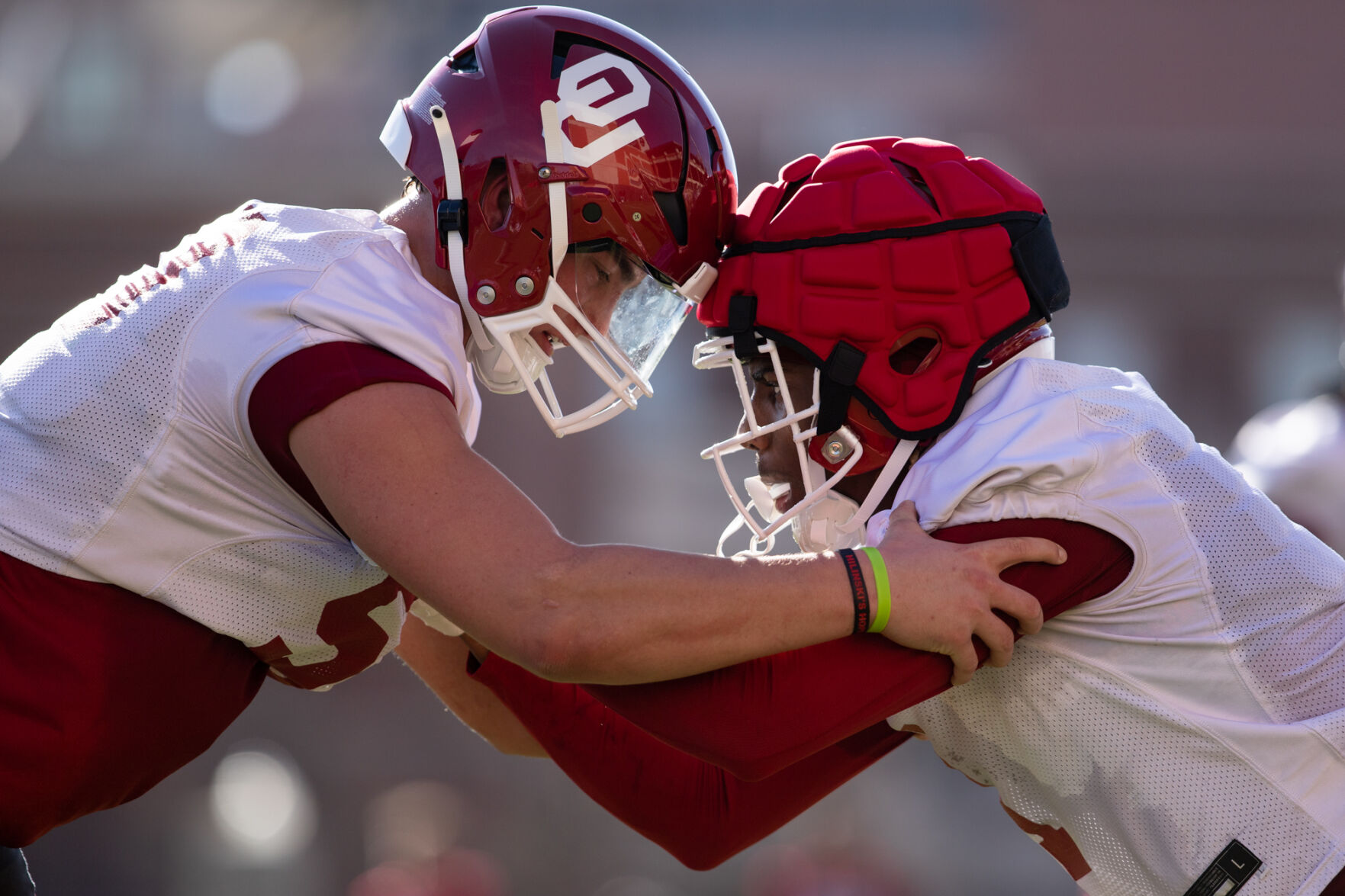
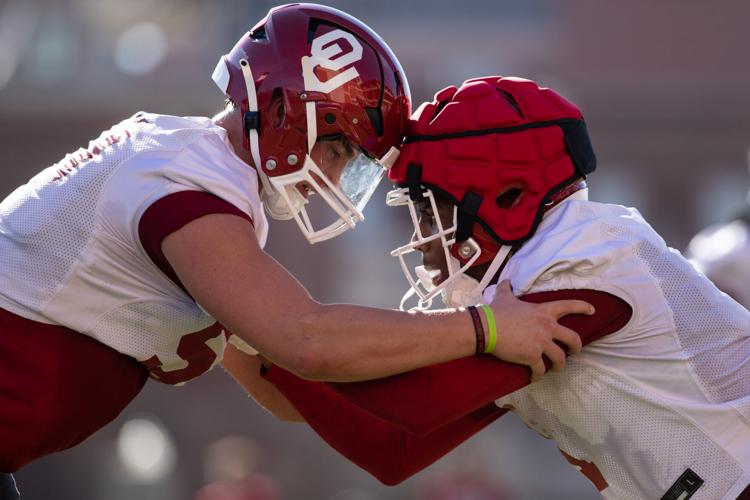
Freshman linebacker Phil Picciotti and sophomore linebacker Dasan McCullough during spring practice on March 21.
'They’re paying the price'
In 1995, Barry Giles and J. R. Conrad once conjured up shirt designs stating: “I don’t want to hear about your cry-baby bullshit, I survived Howard Schnellenberger.”
Of course, for both of Oklahoma’s former offensive lineman, the idea was a fun way to laugh at the hellscape of their time under the former OU head coach. However, the realities behind his tenure reveal a much more grim light on the regimens he put in place and the state of football at the time.
And, while the shirts never came to fruition, the horror stories still remain.
“It was some crazy stuff,” Giles told the OU Daily. “It was about (hiding) the water bottles or how many times have you been dripped (with the IV fluids). Nowadays they use that as a fashion statement.”
The standard practice for Schnellenberger was three hours with one, 15-minute water break in full pads. Sometimes the Sooners would have three practices during the day, and the former coach would keep water from the team.
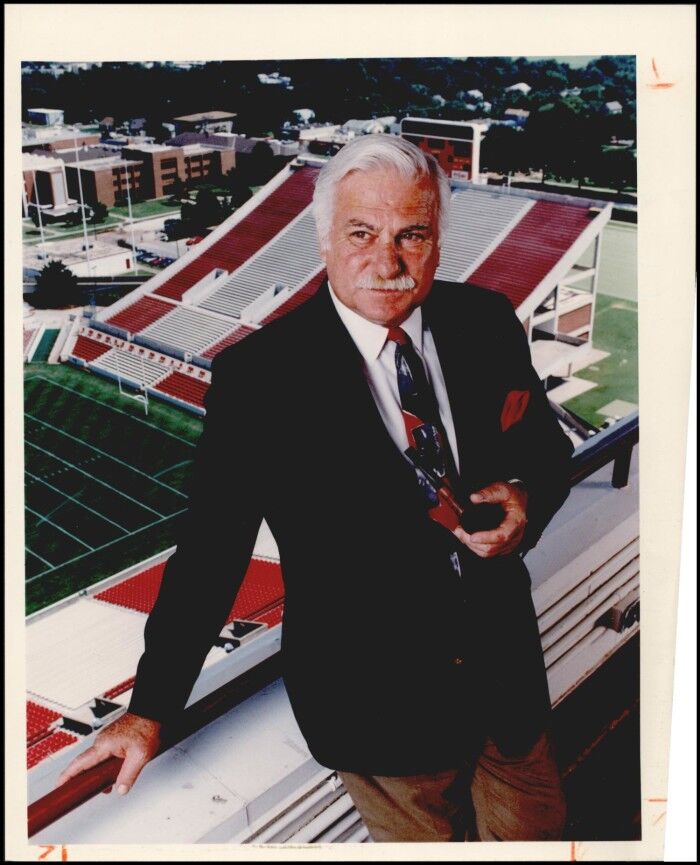
Howard Schnellenberger in 1995.
Giles also remembers hearing a horror story of an unnamed freshman passing out, then incoherently getting up and saying, “Time to go to practice” after a three-hour session in the August heat.
“He didn't know where he was,” Giles said. “He didn't know ‘sick 'em’ from ‘come here.’ Today, if he's outside in the heat at all it'll mess him up. … None of us old vets were there yet because we didn't report yet, but that story was sort of flying around.
“There were probably 12 tables with six lined up against each wall. Each one of those tables had two coat hangers that they had pulled apart so that they could put IV bags to start hanging up.”
During that time, Giles said he remembered seeing six to eight players being carted in the back of a pickup truck to Norman’s local hospital due to passing out from the heat. Now, serving as an assistant coach for Duncan High School, he says he learned from his time under Schnellenberger to always keep his players hydrated.
“I don't want to hear about sprained ACLs and other injuries (as a coach),” Giles said. “But if they say ‘I'm thirsty,’ they’re gonna get their butts over there and drink some water because I remember what that feeling was like.”
Six years later the horrors of heat-related illnesses that existed in Norman were presented on a national scale. Korey Stringer, a defensive lineman for the Minnesota Vikings died of exertional heat stroke in 2001.
For the next eight years, Casa served as an expert witness for the legal proceedings in a case that enacted progressive rule changes in the NFL and landed a legal settlement for the Stringer family.
With the help of NFL commissioner Roger Goodell, he later became the CEO for the KSI institute and a major researcher for solutions to heat-related illnesses in football.
While the NFL and high schools have largely adopted stringent requirements, the NCAA has been reluctant to implement league-wide regulations.
“The NCAA has been slow to adopt requirements,” Casa said. “They may have recommendations out there. … They have not been bold enough to do policies that we see in half of the states.
“They say that they're not in the business of regulating like on site. But it's just so extra because there's concussion regulations and sickle cell trait regulations. … So they've been, unfortunately, behind the times in terms of heat requirements. They're paying the price. I mean, we have kids dying all the time at college level.”
Despite the NCAA’s reluctance to implement change, Oklahoma was quick to change its tune following the firing of Schnellenberger in 1995. Scott Anderson, the Sooners’ former chief athletic trainer who retired from the program in 2022, helped change the culture of OU’s training regimen once he was hired in 1996.
Anderson, and many others’ research around the nation, pioneered the modern understanding for who is at risk for heat-related deaths while playing football.
“What you have to do is identify the at-risk group,” Anderson told the OU Daily. “We've identified that linemen are the at risk group. You have to go back to 1996 to find a high school football player that had a stroke that wasn't one. In the last 23-24 years in college, there's been one non-lineman death from exertional heat stroke, so you have to find that risk group and the activities that are creating the risk.”
The former Oklahoma athletic trainer also found over-conditioning was — and still is — one of the main factors in causing heat-related illnesses and deaths in football. In fact, 37% of heat stroke fatalities in football in the last 20 years have been related to practice-related conditioning punishments according to Anderson.
After having numerous players carted to the hospital during the 1995 season, Anderson successfully had no players hospitalized during his tenure with the Sooners. With his help, Oklahoma has become one of the leading programs in caring and preventing heat-related illnesses and strokes.
“Oklahoma is more proactive than most programs,” Casa said. “That's because they had Scott Anderson down there for so long. He's very in tune with the whole human side of things.”
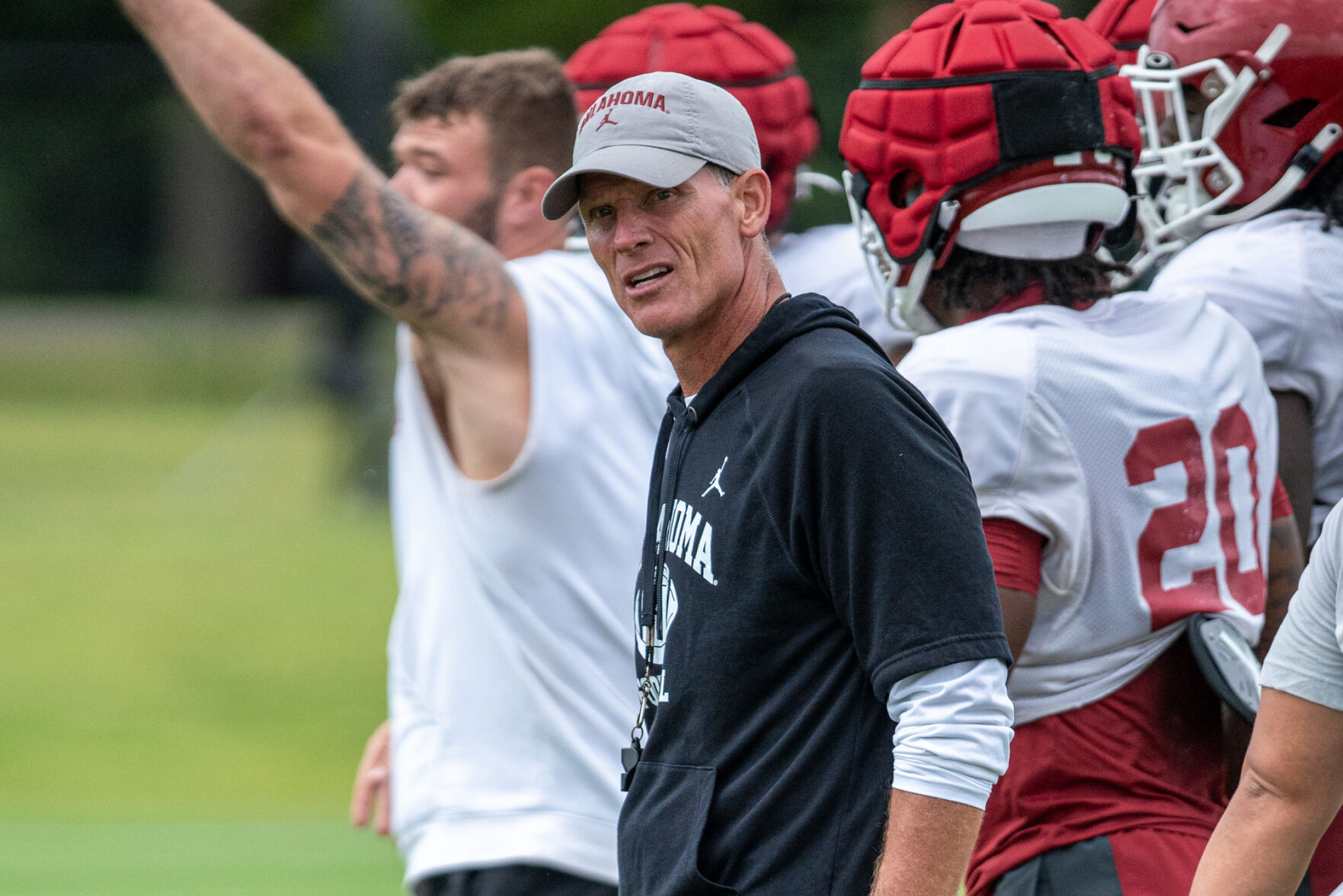
OU football head coach Brent Venables during fall camp on Aug. 14.
'It’s just not safe'
Outside of Oklahoma’s fall training camp in 2023, a refrigerated trailer connected to a semi-truck has been made available to OU’s players during their breaks at practice.
Those trucks also store popsicles and other treats to help keep Oklahoma's players cool during summer practices. The training staff has also given players beet juice, which is said to increase blood flow, oxidization and nutritional minerals in the body.
Sooners defensive lineman Reggie Grimes and Jonah Laulu — members of the most at risk position group for heat strokes in football — raved about the Sooners' training and nutrition staff following its practice on Tuesday.
“Every day before practice they'll have some type of electrolytes or beet juice that helps you in different areas,” Laulu said. “Working out or practicing in insane heat, … it's just a part of the game.”
Jonah Laulu talks the competition with the offensive line with a cameo from #Sooners’ defensive line coach Miguel Chavis; pic.twitter.com/F4OKmKoQRH
— Jason Batacao (@J_batacao) August 23, 2023
Oklahoma’s efforts to stay ahead of the temperatures are led by Robert Fulton, the associate athletic director for athlete medicine.
“It’s a collaborative effort,” Fulton told the Daily. “It’s between a lot of resources from the dieticians, staff and students that they have and athletic trainers, strength conditioning, sports science, so it's kind of attacking it from all angles. Some of the simple measures that we do just for providing resources, snacks, hydration, different options for the guys pretty much throughout the day and impose it throughout class.”
Oklahoma has geared its approach, individually, by having each player weigh in before and after practice to measure the level of fluids they’ve lost. From that metric, the health and nutrition staff will recommend how much each player needs to hydrate throughout the day.
Fulton also leads a team of seven professional athletic trainers that are specific to football. Then there’s 7 to 10 student athletic trainers that stand by at practice to watch players for signs and warnings of any heat-related illness.
They also have sports science machines that measure player’s heart rates and respiration. Oklahoma invested in cold submersible tubs always on standby, in case a player faces a heat stroke.
According to KSI protocol, there is a 100% survivability rate if exertional heatstroke victims have their internal temperatures reduced below 104 degrees within 30 minutes of the onset of symptoms in a cold tub.
“At the end of the day, if we have a concern, we make the appropriate decisions to care for that athlete,” Fulton said. “We'll remove them until we feel like things have stabilized a bit and then we feel like it's safe for them to return.”
He is also in constant communication with Kloesel, and then he relays all that information to the training and nutrition staff. Whether that means practicing inside of the Everest Indoor Training Center, setting up a tent outside or having other means to be prepared, the coaching staff is always informed.
“It's pretty much a continuum,” Fulton said. “It's a continuous conversation based on when we're looking at a plan and trying to outline when and where and what the best time is going to be to ensure we're operating safely.
“We've got all of our emergency equipment, and we've got all of our staff that's trained to recognize and respond to such if and when that were to happen.
Oklahoma’s approach has also extended beyond that of the players, as well, Kloesel is actively looking for preventative solutions for anyone planning to attend the Sooners’ first home game, which is forecasted to have a temperature around 100 degrees.
Everybody, sing along! Da-da-da, dat-da, dat, da-da-da, da-ya-da#okwx #okmesonet pic.twitter.com/iDsdDbuKOL
— Oklahoma Mesonet (@okmesonet) August 23, 2023
“It extends beyond the football team to the fans,” Kloesel said. “We are rapidly preparing for how many cooling stations, how much water we will need to have on site because we know we're gonna sell a ton of water,” We’re making sure that we have relaxed policies, so that people can bring in empty water bottles and refill them in the stadium to keep hydrated.”
While Casa’s future for college football is more grim, Kloesel says working with TV partners might be the first step to finding kickoff times that will have less extreme temperatures.
For him, that’s the a better scenario before football potentially moves to a completely different season.
“I think we're gonna have to be proactive, potentially working with our television partners to rethink those 11 a.m. and 2:30 p.m. games this time of year,” Kloesel said. “Our high school partners are already making those moves. It's a lot easier to move when you don't have a televised game. … But we gotta stop this 11 a.m. nonsense on the first weekend in September, and 2:30 for that matter, as well. It's just not safe.”
This story was edited by Colton Sulley.


